What road salt does to stone steps, walks and stoops, and how to go easier on them
Deicing salt melts ice by turning it into salty water, and that water soaks into stone, brick, mortar and concrete. Inside, it keeps the surface wet longer and adds more freeze and thaw. As it dries, the salt grows crystals in the tiny pores just under the surface and pushes the face off. That is why steps flake near the bottom, treads go rough and a white crust shows along the joints.
- Topic
- Salt on steps, walks and stoops
- Season
- Winter, with a rinse in spring
- From
- Stonecrete Inc, White Bear Lake
- Call or text
- (612) 432-9467
Salt comes from more places than the bag
Most people think about the salt they spread on the front steps. But steps and walks take salt from all over. The city plows throw salty slush onto the boulevard and the end of the driveway. Cars carry it in on their wheels and drip it onto the garage floor and the apron. Shoes track it up the steps and onto the stoop, where it melts and runs into the joints.
So the masonry nearest the street, the driveway and the garage door usually takes the most. Stone steps that meet a salted walk, the bottom of a stone wall along the driveway, and the landing outside the side door can sit in salty meltwater for months.
What the salt does once it is inside
Stone, brick, mortar and concrete all have tiny pores. Salty meltwater soaks into them the same way plain water does. But salt pulls moisture out of the air, so salted masonry stays damp longer after every melt, and damp masonry is the kind the frost breaks.
Salt also means more thawing. It melts ice on the surface on days when the stone just below is still frozen. The meltwater runs into the pores and the joints, and by night it freezes again. A step that would have stayed frozen and quiet for a week gets worked over every day.
Then there is the drying. When salty water dries out of the surface, the salt stays behind as crystals. If they form right on the face, you see them as a white crust. If they form just under it, they grow in the pores and push outward, and the face lets go in thin flakes.
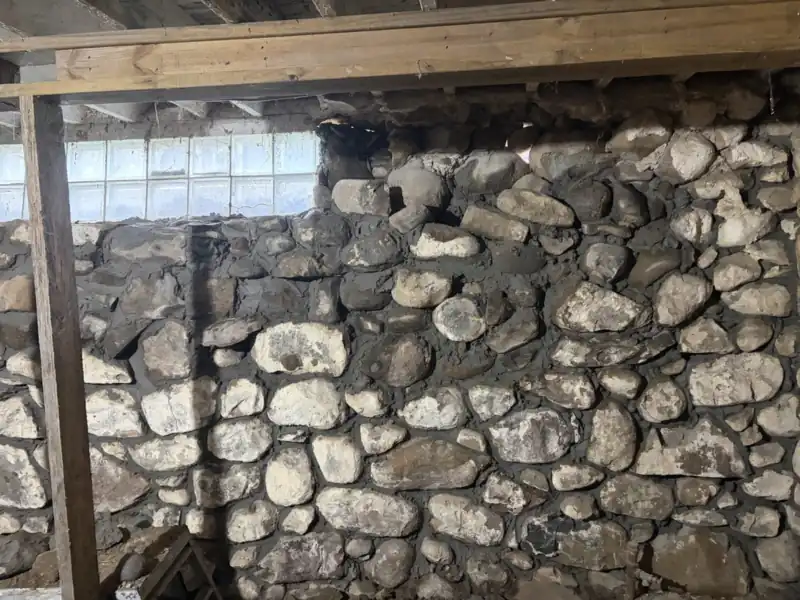
Soft stone like limestone and sandstone shows it fastest. Dense granite holds up better. Old brick spalls, mortar joints wash back, and concrete steps lose their top skin until the gravel inside shows. Metal railings set into stone steps rust in the salt, and rust takes up more room than the steel did, so the stone around the post cracks.
The signs on your steps and walk
Salt damage has a pattern, and once you know it you can spot it from the sidewalk.
- White crust along the joints and the bottom edge of the steps that comes back after you scrub it
- Thin flakes coming off the face, worst at the front edges of the treads and on the bottom step
- Treads that have gone rough and sandy where they used to be smooth
- Joints washed back on the lower steps while the ones higher up still look fine
- Cracks in the stone around railing posts, often with rust stains
- Damage that is worse near the driveway, the walk or a downspout than on the far side of the same steps
White stains from outside and from inside
Not every white stain is road salt. Water moving through any masonry picks up natural salts from inside the stone, brick and mortar, and leaves them on the face as it dries. Masons call that efflorescence. It shows up on walls nowhere near a salted walk.
Road salt tends to sit in a tide line low on steps and walls, at the height the slush reached, and it is heaviest near the street and the driveway. Efflorescence shows up wherever water is coming through, often under a sill or a cap, or in a patch on a foundation.
Either way, brush it off dry with a stiff brush, then rinse with plain water once the weather warms. Do not use acid cleaners on limestone or marble. Acid eats the stone itself. If the white keeps coming back in the same spot season after season, water keeps getting in there, and that is worth tracking down.
Going easier on them in winter
Nobody is going to stop salting their steps in a Minnesota winter, and a fall on ice is worse than a flaked tread. The aim is to use less and let it sit for less time.
- Shovel early and often, so there is less packed snow and ice left to melt
- Spread salt thin where it is needed, then sweep up what is left once the ice is gone
- Use sand or grit on steps for grip. It does not melt anything, but it does not soak in either
- Do not throw salty snow from the driveway onto the steps or pile it against stone walls
- Use a shovel with a plastic edge on stone treads so the edges do not chip
- Fix a gutter that drips onto the steps, since that is where the ice keeps building back
Which deicer to buy
Products sold as gentler on concrete or stone still put salty water into the surface. Some do less harm than plain rock salt, and they can be worth the extra cost on old limestone steps. But how much you put down matters more than which bag it came out of.
Read the label for anything that says it is not for new concrete or not for natural stone, and keep any deicer off fresh mortar from a repair.
Rinsing in the spring
Once the nights stay above freezing, give the steps, the walk and the bottom of any stone walls a good rinse with a garden hose and a soft brush. That washes out the salt sitting in the surface before the spring rains drive it deeper.
Skip the pressure washer on stone steps and old mortar. Up close it can cut soft mortar out of the joints and scar the face of the stone. A hose and a brush is plenty.
After the steps dry is the best time to look them over. Clean stone shows flaking, open joints and cracks much better than stone with a winter of grime on it.
When the steps need more than a rinse
Some damage is past what a hose can help. Flaking that goes deeper each year, treads that rock, joints open on the tops of the steps, a step that has tipped toward the house, or stone cracked around a railing post all let more water in, and the next winter makes them worse.
Stone steps and landings can often be put right without starting over. Loose treads can be lifted and reset, open joints repointed, and a broken piece replaced with stone that matches as close as it can. The stone repair page on this site covers how Don Barger at Stonecrete Inc resets loose stone and repoints joints, and how he looks for the cause, whether that is salt, frost or water running the wrong way.
If your steps are brick or concrete, ask Don about them. Call or text (612) 432-9467 with a photo of the steps from the walk and a close one of the worst tread, and say what town you are in.
Questions
Is sand better than salt for stone steps?
For the stone, yes. Sand does not melt ice, but it gives grip and it does not soak into the stone the way salty water does. A lot of people use a little salt where the ice is worst and sand on the rest. Sweep the sand up in spring so it does not grind on the treads.
Should I seal my stone steps to keep the salt out?
It depends on the stone. Some sealers soak in and slow water down without trapping it. Others form a film that holds water in, and then the face flakes off under the film. Ask before you seal, and never seal steps that are still wet or full of salt.
Why are only my bottom steps falling apart?
Meltwater and slush run down the steps and collect at the bottom, and the salt goes with them. The bottom step also sits closest to wet ground and the salted walk. So it stays wet and salty longer than the steps above it, and it gets the most freeze and thaw.
Can a flaking stone step be fixed?
Often it can. A tread that has lost a thin layer can stay in place if the stone under it is sound and the joints are closed up. A tread that has split or is crumbling deep can be reset or replaced with a matching piece. Send Don a photo and ask which it looks like.
Don tells you plainly what the masonry needs, and what it does not, before any work starts.